How We Decide Between Carbon Fiber, Wall Anchors, and Other Foundation Wall Repairs
When a basement wall starts bowing or cracking, homeowners often begin researching repair systems. Carbon fiber, wall anchors, and steel reinforcement are some of the options they may find, but choosing between them isn't simply a matter of deciding which product is strongest.
We approach bowed wall repair from an engineering perspective. Before recommending a system, we want to understand how the wall is moving, how much soil it is retaining, where the pressure is coming from, and what the repair needs to accomplish. Two walls that look similar can require very different repairs once those factors are considered.
First, We Determine How the Wall Is Moving
Foundation walls don’t always move in the same way. A wall can bow through the middle, lean inward from the top, shift near the bottom, or experience a combination of movements. Horizontal cracks and stair-step cracks can provide useful clues, but a crack by itself doesn’t tell us what repair should be installed.
During an evaluation, we measure the wall and look at where the movement is occurring. We also consider wall height, construction type, exterior grade, drainage, soil conditions, and how the wall is supported at the top and bottom. The goal is to understand how the wall is performing as a structure rather than choosing a repair based on appearance alone.
Soil and Water Matter
A basement wall isn’t just supporting part of the house. It also has to resist pressure from the soil outside. That pressure (called hydrostatic pressure) generally increases farther below grade. Water can make matters worse by saturating the soil and creating additional pressure against the foundation, especially when drainage around the home isn’t working properly.
This is why we look outside during a foundation inspection. Poor grading, short downspouts, drainage problems, and water collecting near the foundation can all contribute to the conditions affecting a basement wall.
When Carbon Fiber Reinforcement Makes Sense
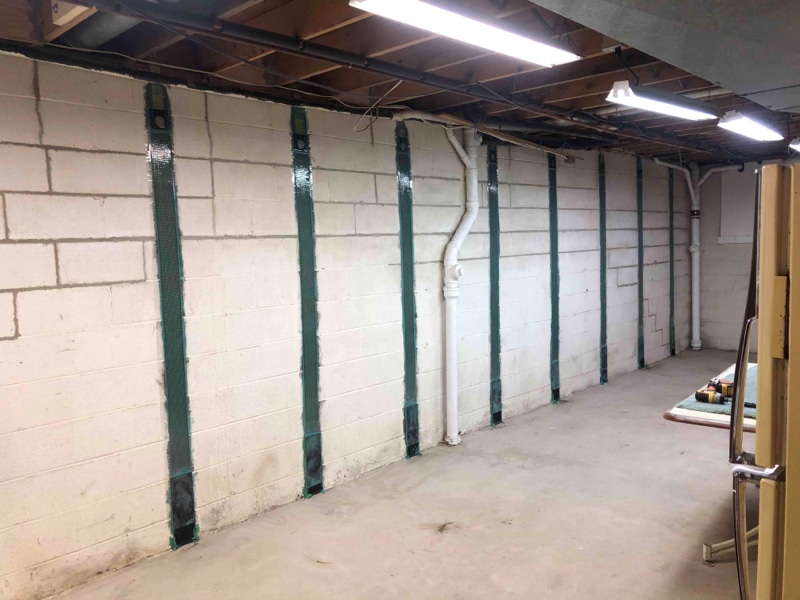
Carbon fiber can be an effective way to stabilize certain bowing foundation walls without taking up much interior space. DESKA uses engineered systems such as Fortress InvisiBeam, which combines carbon fiber and Kevlar reinforcement with top and bottom anchoring.
What’s important from an engineering standpoint isn’t simply that carbon fiber is strong. It’s how the reinforcement is designed for the wall.
Fortress’ published engineering tables consider factors including wall height, unbalanced backfill height, and equivalent fluid pressure from the soil. As structural demand increases, the required reinforcement spacing can become tighter. For an 8-foot CMU wall under the conditions covered by Fortress’ tables, spacing ranges from 48 inches on center under lower-demand conditions to 24 inches on center under higher-demand conditions.
That’s a good example of why we don’t use a universal rule such as placing a strap every four feet. The repair needs to reflect the loads acting on that particular wall.
The Fortress Carbon Grid Strap evaluated under ICC-ES ESR-3815 has a published design ultimate tensile strength of 234.7 ksi and design tensile modulus of 16,300 ksi in its primary direction. Those are impressive numbers, but they’re only part of the engineering. Proper spacing, anchoring, wall condition, and installation all affect how the completed system performs.
When Wall Anchors May Be a Better Choice
Wall anchors work differently. They connect the foundation wall to anchors installed in stable soil outside the home. Depending on the condition of the wall and the design of the system, anchors may be considered when stabilization or some degree of wall correction is the goal.
The property itself can determine whether they’re practical. We have to consider soil conditions along with driveways, patios, utilities, landscaping, property lines, and the amount of exterior access available. This is another reason we don’t recommend wall anchors simply because a wall has moved a certain distance. The repair has to work with both the structure and the site around it.
What About Steel Reinforcement?
Steel beams can still be appropriate for certain foundation walls. Properly designed steel reinforcement can provide substantial resistance to continued movement, although it typically takes up more interior space than carbon fiber.
Again, we’re interested in more than the material. We need to know how the steel will be restrained, where the loads will transfer, and whether the surrounding structure can support those forces. For a finished basement, the amount of space a system occupies may also become part of the conversation.
Severe Wall Movement Requires a Closer Look
When our structural engineers evaluate a bowing or damaged foundation wall, we’re looking at the entire problem. That typically includes:
- How the wall is moving
- Wall height and construction
- Amount of soil retained outside the wall
- Crack location and direction
- Amount of measured deflection
- Top and bottom restraint
- Soil and drainage conditions
- Condition of the concrete or masonry
- Previous repairs
- Exterior access
- Whether the basement is finished
- Whether the goal is stabilization or correction
Sometimes more than one system can solve the structural problem. When that’s the case, we can also consider disruption, cost, available space, and the homeowner’s plans for the basement.
We Choose the Repair After We Understand the Wall
Homeowners often ask whether carbon fiber is better than wall anchors or whether steel is stronger than carbon fiber. There isn’t a universal answer. The better question is what the damaged wall needs.
At DESKA, we first determine how the wall has moved and what forces the repaired wall needs to resist. From there, we can decide whether an engineered carbon fiber system, wall anchors, steel reinforcement, drainage improvements, wall straightening, or another approach makes sense. That’s the advantage of approaching foundation wall repair from an engineering perspective. The diagnosis determines the repair, not the product.
Contact Us for Bowed Wall Repair in Alexandria
If you’ve noticed horizontal cracks, bowing, leaning, or other movement in a basement wall, our team can determine what’s happening before recommending a repair.
Our structural engineering team evaluates the wall movement, structural loads, soil and drainage conditions, and the rest of the foundation to determine which repair approach fits the problem. Contact us to schedule a foundation evaluation and get a clearer understanding of what your wall actually needs.