Carbon Fiber Foundation Wall Repair in DC, Northern Virginia & Maryland
A horizontal crack, inward curve, or movement along a basement wall can be a sign that outside pressure is beginning to exceed what the wall can resist. Carbon fiber reinforcement may be able to stabilize the wall, but we do not recommend it based on the appearance of one crack or a simple measurement alone.
At DESKA, our team evaluates how the wall is moving, how it is constructed, how much soil it retains, and what forces the repaired wall needs to resist. If carbon fiber is the right solution, we install engineered reinforcement systems designed to stabilize the wall while taking up very little space inside your basement.
We provide carbon fiber foundation repair throughout Northern Virginia, Washington, DC, and Maryland. Our team includes licensed Professional Engineers, structural professionals, and trained foundation repair crews who can evaluate the problem and explain which repair makes sense for your home.
When Carbon Fiber Reinforcement May Be Right for Your Wall
Carbon fiber reinforcement is designed to strengthen certain foundation walls that are cracking, bowing, leaning, tipping, or experiencing other forms of lateral movement. The system is installed on the interior face of the wall and reinforces it against continued movement.
Homeowners often first notice symptoms such as:
- A long horizontal crack across a basement wall
- Stair-step cracking through a block wall
- A visible inward curve
- Movement near the top of the wall
- Movement near the bottom of the wall
- Cracks that reopen after previous repairs
- Gaps or separation around the affected wall
- Changes that become more noticeable over time
Seeing one of these conditions does not automatically mean carbon fiber is the correct repair. We first need to determine how the wall is moving and whether the wall is in suitable condition for reinforcement.
That is an important distinction. Carbon fiber is one tool we use for foundation wall repair, not the answer to every damaged wall.
What Causes Foundation Walls to Bow?
Basement walls have to do more than support parts of the house above them. They also resist soil and water pressure from outside.
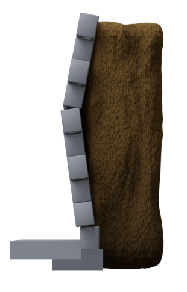
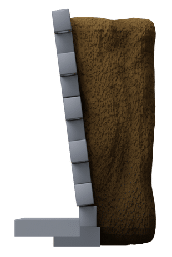
When that lateral pressure becomes greater than the wall can resist, cracking or movement can develop. Depending on the wall and the forces acting on it, we may see bowing through the middle, tipping near the top, movement near the bottom, or a combination of these conditions.
Soil Pressure and Moisture
The soil placed against a basement wall creates lateral pressure. Changes in moisture can make those conditions more demanding, especially when water collects around the foundation or when expansive soil changes volume.
Poor grading, short downspouts, drainage problems, and concentrated runoff can also affect the conditions around a basement wall. When we evaluate a bowing wall, our team does not look only at the concrete or block inside the basement. We also want to understand what is happening outside.
Structural reinforcement can stabilize a wall that has moved, but drainage or water-management improvements may also be appropriate when those conditions are contributing to the problem.
Northern Virginia Soil and Backfill Conditions
Soil conditions vary throughout Northern Virginia, but portions of the region contain shrink-swell soils that can create substantial pressure against foundation walls. The type of backfill placed against the wall and the amount of moisture it contains can both affect the loads the wall experiences.
That does not mean every bowed wall in Northern Virginia has the same cause. Two homes on the same street can have different backfill, grading, drainage, wall construction, and repair histories.
Our team evaluates those property-specific conditions before developing the repair.
How We Determine Whether Carbon Fiber Is the Right Repair
One of the most important parts of carbon fiber foundation repair happens before we install anything.
Our engineers and foundation team evaluate how the wall is performing as a structure. We want to know where it has moved, how it is restrained, what loads it is resisting, and what the completed repair needs to accomplish.
Depending on the property, we may evaluate:
- Wall height
- Wall construction
- Crack location and direction
- Amount and pattern of movement
- Soil retained outside the wall
- Exterior grade
- Drainage conditions
- Top restraint
- Bottom restraint
- Condition of the masonry or concrete
- Previous repairs
- Exterior access
- Finished basement conditions
- Whether the goal is stabilization or correction
We do not use one universal rule that says every wall below a certain amount of movement gets carbon fiber. A wall with limited bowing but poor masonry may require a different approach than a wall with similar movement that is otherwise in good structural condition.
The repair needs to fit the wall.
If you have a horizontal crack or a wall that appears to be moving inward, schedule an inspection with our team.
Why We Use the Fortress InvisiBeam System
DESKA is certified to install Fortress Stabilization Systems carbon fiber reinforcement. For appropriate foundation walls, we use the Fortress InvisiBeam system because it combines carbon fiber reinforcement with structural anchoring and an engineered installation approach.
What matters to us is not simply that carbon fiber is strong. The complete system has to transfer loads effectively through the repaired wall.
Carbon Fiber and Kevlar Reinforcement
The InvisiBeam system uses a carbon fiber and Kevlar grid rather than a simple sheet of carbon fiber fabric.
The open-grid construction allows the structural epoxy to bond the reinforcement to the wall while also passing through openings in the grid. Once installed as part of the complete system, the reinforcement helps the wall resist continued lateral movement.
Carbon fiber is also noncorrosive. Unlike exposed steel, it will not rust from normal basement humidity or moisture.




Top and Bottom Structural Anchoring
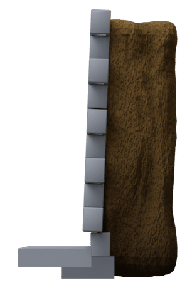
The InvisiBeam system is designed as more than a strip bonded to the middle of a wall.
The reinforcement is connected at the top and bottom so loads can be transferred into structural restraint points rather than relying solely on a surface bond. The exact anchoring details depend on the structure and installation conditions.
This is especially important when we are evaluating movement such as tipping or shearing. Our team wants the complete reinforcement system to address the way the wall is actually moving.
Low-Profile Interior Installation
One of the practical advantages of carbon fiber is how little interior space it requires.
Traditional steel reinforcement can project farther into a basement and may interfere with finished walls, mechanical equipment, or future basement plans. InvisiBeam remains close to the wall surface and can often be painted or concealed as part of a finished basement.
Carbon fiber installation also generally does not require the exterior excavation associated with some wall anchor or wall-straightening methods.
That can make it a useful option where landscaping, patios, driveways, utilities, neighboring properties, or other conditions make exterior work difficult.
How We Design a Carbon Fiber Wall Repair
Carbon fiber straps should not simply be placed at arbitrary intervals along a wall.
The number and spacing of reinforcement locations depend on the structural demand placed on the wall. Factors such as wall height, retained soil height, soil pressure, wall construction, and other design conditions can influence how closely reinforcement needs to be installed.
That is why our team does not rely on a universal spacing rule.
When structural demand increases, reinforcement requirements may change. Our engineers evaluate the conditions and determine the repair layout appropriate for the wall.
This engineering step is one of the reasons we believe the design of a carbon fiber system matters just as much as the strength of the material itself.
How Carbon Fiber Straps Are Installed
The exact installation depends on the wall and repair design, but a carbon fiber reinforcement project generally begins with documenting the wall condition and laying out the reinforcement locations.
Evaluate and Measure the Wall
Before installation, our team evaluates the wall and confirms the repair layout. We document the movement, wall construction, surface condition, and other factors that affect the repair.
Prepare the Wall Surface
The reinforcement needs a suitable surface for bonding. Paint, coatings, loose material, and other surface conditions may need to be removed where the system will be installed.
Surface preparation is an important part of the repair. A high-strength product cannot perform as designed if it is installed over an unsuitable surface.
Apply the Structural Epoxy and Reinforcement
The specified structural epoxy is applied at each reinforcement location, and the carbon fiber/Kevlar grid is installed according to the system requirements.
The open-grid design allows the epoxy and reinforcement to work together as a composite system.
Install the Structural Anchors
The top and bottom anchoring components are installed as required by the design and structure.
These anchors help connect the reinforcement to the structural restraint at each end of the wall rather than relying on the center portion of the strap alone.
Complete and Review the Installation
Once the system is installed, our team reviews the completed work and any related repairs included in the project.
Because the finished reinforcement remains close to the wall surface, homeowners can often paint or finish over it later, subject to the system requirements.
Carbon Fiber vs. Wall Anchors and Steel Reinforcement
Carbon fiber, wall anchors, and steel reinforcement are not three interchangeable versions of the same repair.
Each foundation repair system handles structural forces differently. When we evaluate your wall, our job is to determine which approach fits the movement, site conditions, and repair objective.
When Carbon Fiber Makes Sense
Carbon fiber may be a good option when the wall can be stabilized from the interior and the existing wall is suitable for reinforcement.
It can be especially attractive when:
- A low-profile repair is important
- Exterior excavation is difficult or undesirable
- The wall condition supports bonded reinforcement
- The repair goal is primarily stabilization
- A finished basement or future finishing is a consideration
These factors alone do not determine the repair. They are part of the overall evaluation.
When Wall Anchors May Be Better
Wall anchors work by connecting the foundation wall to an anchor located in suitable soil outside the home.
Depending on the wall and system, anchors may provide an option when greater correction is desired or when the structural conditions make an anchored repair more appropriate.
Exterior conditions matter. Patios, driveways, property lines, landscaping, utilities, and neighboring structures can all affect whether an anchor system is practical.
When Steel or Another Repair May Be Needed
Steel reinforcement can still be an appropriate solution for certain foundation walls. It usually occupies more interior space than carbon fiber, but properly designed steel can provide substantial structural resistance.
Walls with extensive deterioration, unusual construction, advanced displacement, failed masonry, or other structural complications may also require a different repair approach.
We do not want to sell you carbon fiber simply because you landed on our carbon fiber page. We want to determine what your wall actually needs.
Stabilizing a Wall vs. Straightening It
Carbon fiber reinforcement is commonly used to stabilize a wall and resist additional movement. Stabilization and straightening are not necessarily the same objective.
A wall that has already moved may not need to be returned completely to its original position to achieve the structural goal of the repair. In other cases, correction may be desirable and another repair method may be more appropriate.
When our engineers evaluate your wall, we want to establish that objective before recommending a system.
We will explain whether the proposed repair is intended to stabilize the wall in its current position, provide some correction, or work as part of a larger wall-straightening or structural repair project.
What Affects Carbon Fiber Foundation Repair Cost?
The cost of a carbon fiber wall repair depends on more than the price of an individual strap.
Factors that can affect your project include:
- Wall height
- Length of the affected wall
- Number and spacing of reinforcement locations
- Wall construction
- Amount and type of movement
- Surface preparation
- Existing coatings or finishes
- Top and bottom anchoring conditions
- Framing configuration
- Engineering requirements
- Access
- Existing crack repairs
- Drainage or waterproofing work
- Other structural repairs included in the scope
A wall requiring six reinforcement locations is a different project from one requiring a much tighter engineered spacing or additional structural work.
Our team evaluates the wall before preparing a project-specific recommendation and estimate.
We also offer financing through Momnt for qualified borrowers.
Why Homeowners Choose DESKA for Carbon Fiber Wall Repair
DESKA was founded in 2012, and our company combines structural engineering and construction capabilities under one team.
Our relevant qualifications include Professional Engineering licenses in Virginia, Washington, DC, and Maryland, a Virginia Class A Contracting License, and certification for Fortress Stabilization Systems carbon fiber installation.
That combination matters for this type of repair. Carbon fiber reinforcement is not simply a material applied to a crack. Someone needs to understand how the wall is moving, determine the structural demand, design the reinforcement layout, prepare the wall correctly, and install the complete system as intended.
We also offer up to a lifetime warranty on qualifying structural repairs. Fortress provides manufacturer warranty coverage for qualifying InvisiBeam installations according to its warranty requirements. The specific coverage for your project will be identified in your written agreement and applicable manufacturer documentation.
Our goal is to give you a repair we can explain from the initial inspection through installation.
Carbon Fiber Foundation Repair Across the DC Metro Area
Our team installs carbon fiber foundation reinforcement throughout Northern Virginia, Washington, DC, and portions of Maryland.
In Virginia, we work throughout Alexandria, Arlington, Fairfax County, Loudoun County, Prince William County, Manassas, Stafford, and surrounding communities. We also serve Washington, DC and numerous communities throughout Montgomery, Prince George’s, Howard, Charles, Calvert, and Anne Arundel counties in Maryland.
The conditions affecting basement walls can vary throughout this service area. Wall construction, soil, backfill, grading, drainage, and home age can all differ from property to property.
That is why our recommendation begins with your wall rather than a general assumption about your neighborhood.
Carbon Fiber Foundation Repair FAQs
Are carbon fiber straps right for every bowed foundation wall?
No. Carbon fiber is one of several methods we use to stabilize foundation walls.
Our team evaluates how the wall has moved, its construction and condition, the structural loads, soil and drainage, top and bottom restraint, and the goal of the repair before recommending a system.
How do I know if my wall needs carbon fiber or wall anchors?
You should not have to make that decision yourself.
Carbon fiber and wall anchors transfer forces differently and have different installation requirements. We evaluate both the wall and the property before deciding which repair fits the problem.
Will carbon fiber straighten my bowed wall?
Carbon fiber is generally used to stabilize a wall and resist continued movement. That does not automatically mean the wall will be returned to its original position.
If wall correction is an important goal, our team will evaluate whether the proposed system can accomplish that or whether another repair approach is more appropriate.
How many carbon fiber straps will my wall need?
There is no universal number or spacing that applies to every wall.
The reinforcement layout depends on factors such as wall height, retained soil, structural demand, construction, and other design conditions. Our team determines the spacing from the conditions affecting your wall.
Do carbon fiber straps require excavation outside my home?
Carbon fiber reinforcement is installed primarily from the interior and generally does not require the type of exterior excavation associated with wall anchors or wall-straightening work.
Other project conditions may still require exterior work, particularly when drainage or another contributing condition also needs to be addressed.
Can carbon fiber straps be covered or painted?
The InvisiBeam system is designed to remain close to the wall surface. Depending on the finishing materials and manufacturer requirements, the completed reinforcement can often be painted or concealed as part of a finished wall.
If you plan to finish the basement, let us know during the inspection so we can consider that in the repair discussion.
Can poor drainage contribute to a bowed basement wall?
Yes. Water around a foundation can affect both soil conditions and the pressure acting against basement walls.
When we inspect a bowed wall, we may also evaluate grading, gutters, downspouts, drainage, and water collection around the affected area.
Does DESKA use Fortress InvisiBeam?
Yes. We are certified to install Fortress Stabilization Systems carbon fiber reinforcement and use the InvisiBeam system where it is appropriate for the wall and repair design.
The system combines carbon fiber and Kevlar reinforcement with structural anchoring at the top and bottom.
Does carbon fiber foundation repair have a warranty?
DESKA offers up to a lifetime warranty on qualifying structural repairs, and Fortress provides manufacturer warranty coverage for qualifying installations according to its warranty terms.
The exact warranty applicable to your project will be identified in the written agreement and manufacturer documentation.
How much does carbon fiber wall repair cost?
Cost depends on the size and condition of the wall, number and spacing of reinforcement locations, surface preparation, structural anchoring, engineering, access, and whether other work is required.
Our team needs to evaluate the wall before providing a project-specific repair estimate.
Schedule a Foundation Wall Inspection
If you have noticed horizontal cracking, inward bowing, tipping, shearing, or another change in a basement wall, we can help you determine what is happening before choosing the repair.
Our engineers and foundation team will evaluate the wall, explain what we find, and determine whether carbon fiber, wall anchors, steel reinforcement, drainage improvements, or another repair approach fits the problem.
If carbon fiber is appropriate, we will design the reinforcement around the wall and structural conditions rather than installing a one-size-fits-all system.