Carbon Fiber Straps vs Wall Anchors: Which Is Better?
If you’ve been told your basement wall is bowing or starting to move, you’ll usually hear about two main repair options. Carbon fiber straps or wall anchors.
At first glance, they sound like two ways to fix the same problem. But they’re designed for different situations, and choosing the right one depends on how much the wall has moved and what’s causing it.
Quick Answer
- Carbon fiber straps are best for stopping movement early when the wall is still mostly intact
- Wall anchors are used when the wall has already moved significantly and needs to be pulled back
In many Northern Virginia homes, carbon fiber is the preferred solution because it stabilizes the wall without major excavation.
Why Basement Walls Start Bowing
Before comparing solutions, it helps to understand the problem. In the Alexandria and Northern Virginia area, soil conditions are a big factor. Clay heavy soils, heavy rainy seasons, and hydrostatic pressure builds against the foundation walls causing them to lean or start to bow inward over time. You may even see foundation cracks, or water intrusion along with the bowed walls. Once thae movement starts, it usually continues unless something stops it.
What Carbon Fiber Straps Do
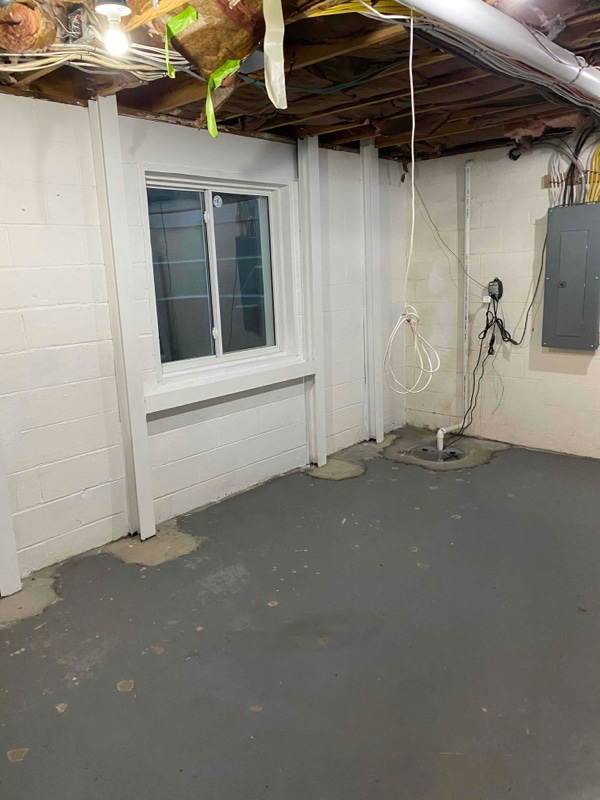
Carbon fiber straps are installed directly onto the interior surface of the wall. They’re bonded with a high-strength epoxy and create a rigid reinforcement that prevents further movement.
Key benefits:
- Extremely strong tensile strength
- Low profile (doesn’t take up space)
- No exterior excavation required
- Fast installation
Once installed, the wall is essentially locked in place.
What Wall Anchors Do
Wall anchors take a different approach. They connect the wall to stable soil outside your home using a steel rod and anchor plate. The system is tightened over time to:
- Stabilize the wall
- Potentially pull it back toward its original position
Wall anchors require:
- Excavation in the yard
- Enough space outside for installation
They’re more involved but useful in certain cases.
The Real Difference: Stabilization vs Correction
This is where most homeowners get confused.
- Carbon fiber = stops movement
- Wall anchors = stop movement + potential correction
Carbon fiber doesn’t straighten a wall. It prevents it from getting worse.
Wall anchors can sometimes improve the wall’s position over time.
When Carbon Fiber Is the Better Option
Carbon fiber is typically the better choice when:
Early-stage bowing is
visible in the wall
Cracks are present
but not severe
You want a clean,
low-profile solution
Exterior access
is limited
Avoid excavation
near the home
This is why it’s commonly used in Northern Virginia homes.
It solves the problem without major disruption.
When Wall Anchors Make More Sense
Wall anchors are usually recommended when:
- The wall has significant inward movement
- Bowing is more advanced
- There’s enough yard space for installation
- Some correction is desired
They’re a stronger corrective option when movement has gone further.
Which One Is Better?
There’s no one-size-fits-all answer.
- If the goal is early intervention and stabilization, carbon fiber is often the better option
- If the wall has already moved significantly, anchors may be needed
The best solution depends on how far the wall has progressed.
What Most Homeowners Get Wrong
A common mistake is waiting too long. Once a wall has moved significantly, carbon fiber may no longer be enough on its own. At that point, more aggressive solutions like anchors become necessary. Another mistake is assuming all bowing walls need to be “pushed back.” In many cases, stabilization is the priority, not reversal.
Contact DESKA Foundation Repair
If you’re noticing cracks or bowing in your basement walls, it’s worth having it evaluated before the problem progresses. We help homeowners throughout Alexandria and Northern Virginia determine the right solution based on the condition of the wall and the surrounding soil.
Contact our team today to schedule an inspection and get a clear recommendation for your home.