Push Piers vs. Helical Piers: Which Foundation Solution Is Right for Your Home?
When you start seeing cracks in your walls, sticking doors, or sloping floors, it is natural to wonder how serious the problem is and how to fix it the right way. For many homes in Alexandria, Arlington, Fairfax, and the surrounding Northern Virginia area, the most reliable long term solution for foundation settlement is a steel pier system.
At DESKA, we use engineer backed pier systems to stabilize and in many cases lift settled foundations. Two of the most commonly recommended solutions are push piers and helical piers. They look somewhat similar, but they are not identical and they are not used the same way on every project.
This guide will walk you through:
- What push piers and helical piers are
- How each system works
- When one pier type is better than the other
- A simple comparison to help you understand the differences
Our goal is to help you talk confidently about options when you meet with a foundation repair expert.
What Are Steel Piers and Why Are They Used?
Steel piers are structural supports that are installed under your existing foundation. Their job is to:
- Bypass soft, shrinking, or shifting surface soils
- Transfer the weight of your home down to deeper, more stable soils or bedrock
- Stop ongoing settlement and, where possible, lift the structure closer to its original position
In Northern Virginia, many homes sit over clay rich and moisture sensitive soils that expand when wet and shrink when dry. Over time, that movement can cause parts of the foundation to sink. Steel piers are often the most reliable way to restore support and protect your investment.
The two main types DESKA uses are push piers and helical piers.
What Are Push Piers?
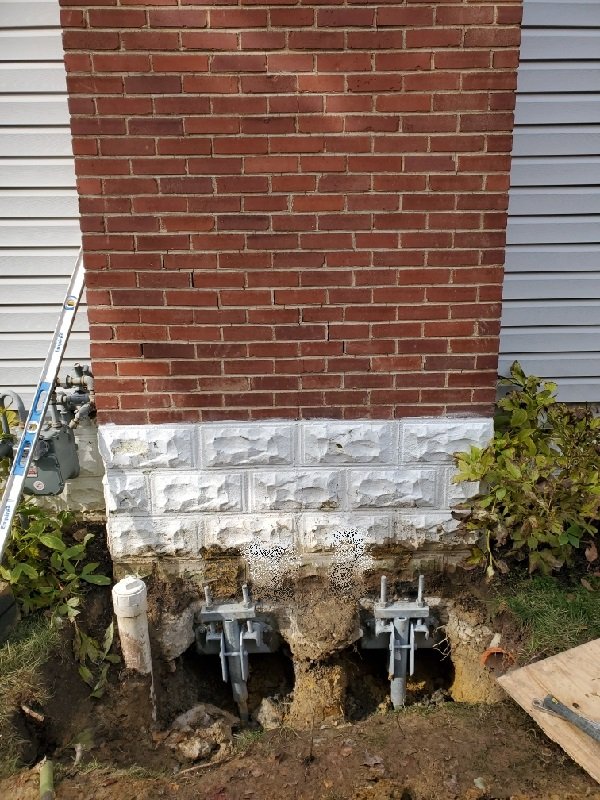
Push piers, sometimes called resistance piers, are steel tubes that are driven into the ground using the weight of the structure as resistance.
How Push Piers Work
- DESKA exposes small sections of the footing in the areas that have settled.
- Heavy duty steel brackets are mounted to the foundation footing.
- Steel pier sections are hydraulically driven straight down through the weak upper soils.
- Piers are pushed until they reach load-bearing strata or bedrock that can support the structure.
- Once proper depth and capacity are reached, hydraulic jacks are used to carefully lift and stabilize the foundation.
- The system is locked off and the soil is backfilled.
Because push piers use the weight of the structure during installation, they are best suited for heavier homes, such as brick houses, two story structures, or homes with substantial masonry loads.
Advantages of Push Piers
- Well suited for significant settlement or heavily loaded areas of the foundation
- Excellent when bedrock or very dense soil can be reached at a practical depth
- Uses the structure’s weight to achieve high load capacity and long term performance
- Often preferred under main foundation walls that support most of the house
What Are Helical Piers?
Helical piers are steel shafts with one or more spiral shaped plates welded along the shaft. Think of them as large structural screws that are torqued into the ground.
How Helical Piers Work
- The footing is exposed along the section of foundation that needs support.
- Helical pier shafts are hydraulically rotated into the soil.
- As the helices advance, the installation torque is monitored to confirm that the pier has reached suitable load bearing soil.
- Once the design depth and torque are achieved, a bracket connects the pier to the foundation footing.
- The piers are then used to stabilize and, in many cases, lift the settled section.
Because helical piers do not rely on the building’s weight for installation, they can be ideal for lighter structures and areas where push piers would not achieve proper capacity.
Advantages of Helical Piers
- Great for porches, additions, sunrooms, and some crawl space foundations
- Helpful in areas with softer surface soils or uncontrolled fill
- Capacity can be verified in real time by torque readings during installation
- Often preferred where vibration from driving push piers needs to be minimized or where access is tight
Push Piers vs. Helical Piers: A Simple Comparison
Here is a quick side by side look at how the two systems compare.
Feature / Factor | Push Piers | Helical Piers |
Installation Method | Piers are driven using the structure’s weight | Piers are screwed (torqued) in with hydraulics |
Load Reaction | Requires enough building weight to resist driving | Does not rely on structure weight |
Best For | Heavier homes, deep or severe settlement | Lighter structures, additions, porches, some slabs |
Soil Conditions | Works well when deep dense soils or bedrock exist | Ideal where soft or fill soils sit over stable layers |
Capacity Verification | Based on depth and hydraulic pressure | Based on measured torque during installation |
Typical Use Around NOVA | Main foundation walls and heavily loaded areas | Porches, additions, crawl space supports, select walls |
Lift Potential | Often excellent for major lifts | Very good for moderate settlement |
Vibration / Disturbance | Some vibration during driving | Typically lower vibration during installation |
Both systems, when properly designed and installed, provide strong, long-lasting support. The best option depends on the type of structure, soil conditions, and severity of settlement.
How DESKA Decides Which Pier System to Use
At DESKA, we do not use a one size fits all approach. Every foundation and every site is a little different in Alexandria, Arlington, Fairfax, and the surrounding markets.
When we evaluate your home, we look at:
- The construction type: full basement, crawl space, slab on grade, porch, or addition
- The weight and layout of the structure
- The pattern and severity of settlement
- Site conditions such as slopes, drainage, and access
- What we know about local soil profiles and fill from work in your neighborhood
From there, we choose push piers, helical piers, or a combination, based on engineering data and manufacturer specifications, not guesswork. The goal is a repair that is appropriate for your home and designed to perform over the long term.
Why Engineer Backed Repairs Matter
Foundation piers are structural components. They are not just a product, they are part of a system that has to be designed correctly.
An engineer backed pier repair means:
- Pier spacing, layout, and capacities are calculated based on actual loads
- The selected system is appropriate for the soil and the structure type
- Installation follows tested procedures and quality standards
- The repair is supported by data, not just rules of thumb
This is especially important in areas with variable clay soils and moisture swings, like much of Northern Virginia.
Common Signs You May Need Steel Pier Repair
No matter which pier solution is right for your home, the warning signs of foundation settlement are often the same. Watch for:
- Stair-step cracks in brick or block walls
- Vertical or diagonal cracks in foundation walls
- Interior drywall cracks above doors and windows
- Doors and windows that stick, rub, or will not latch
- Floors that feel sloped or uneven
- Gaps between walls and ceilings or baseboards
- Chimneys, porches, or stoops pulling away from the main structure
If you are seeing several of these issues, your foundation may already be moving.
Talk to DESKA About Steel Pier Repair in Northern Virginia
You do not have to decide between push piers and helical piers on your own. That is our job.
When you call DESKA, we will:
Perform a detailed inspection of your foundation and the surrounding property
Identify what kind of settlement is occurring and why
Explain whether push piers, helical piers, or a combination make the most sense
Provide an engineer backed repair plan tailored to Alexandria and Northern Virginia soil conditions
If you are noticing more than one of these warning signs, there is a good chance your foundation is reacting to shifting soils.
Ready to Find the Right Foundation Solution?
If you are worried about settlement, cracked walls, or sloping floors, the sooner you address the problem, the easier and more cost effective the repair usually is.
Contact DESKA today to schedule a foundation evaluation.
We will help you understand your options, compare push piers and helical piers for your specific home, and design a steel pier repair that keeps your foundation stable and your home protected for years to come.